V3
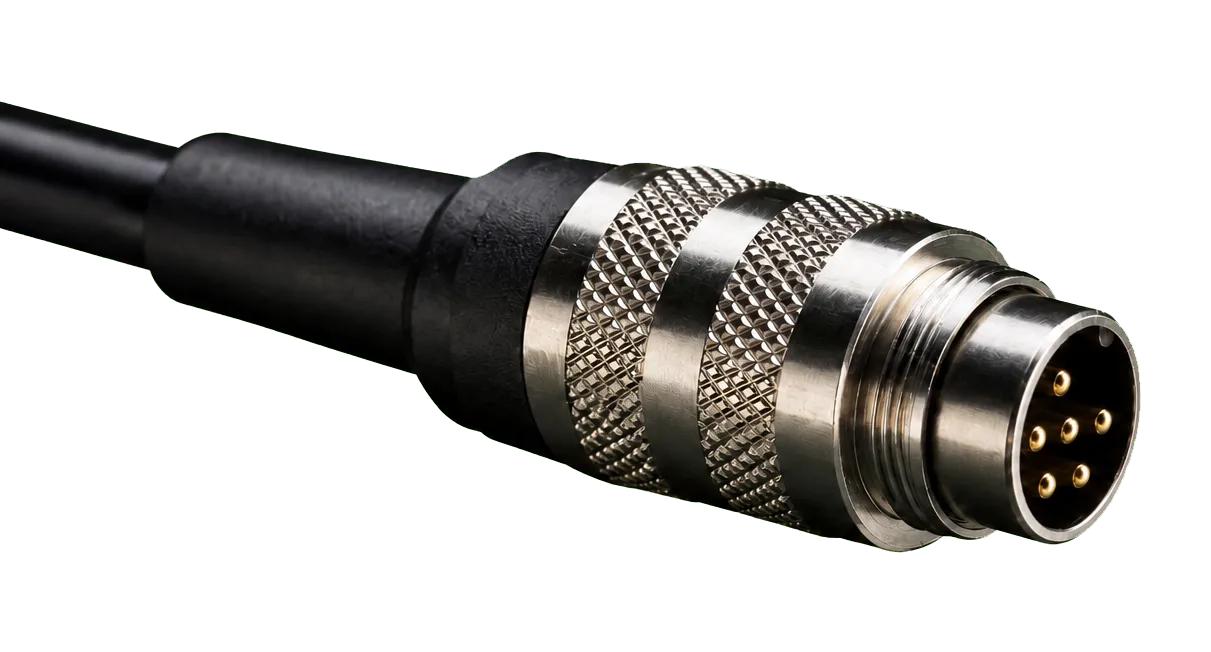
6-pin AUX
Dedicated version for 10Micron V3 controllers with direct hardware status monitoring.

A network-connected control and synchronization system that continues collecting and delivering operational data to the mount — even when the Windows application is not running.
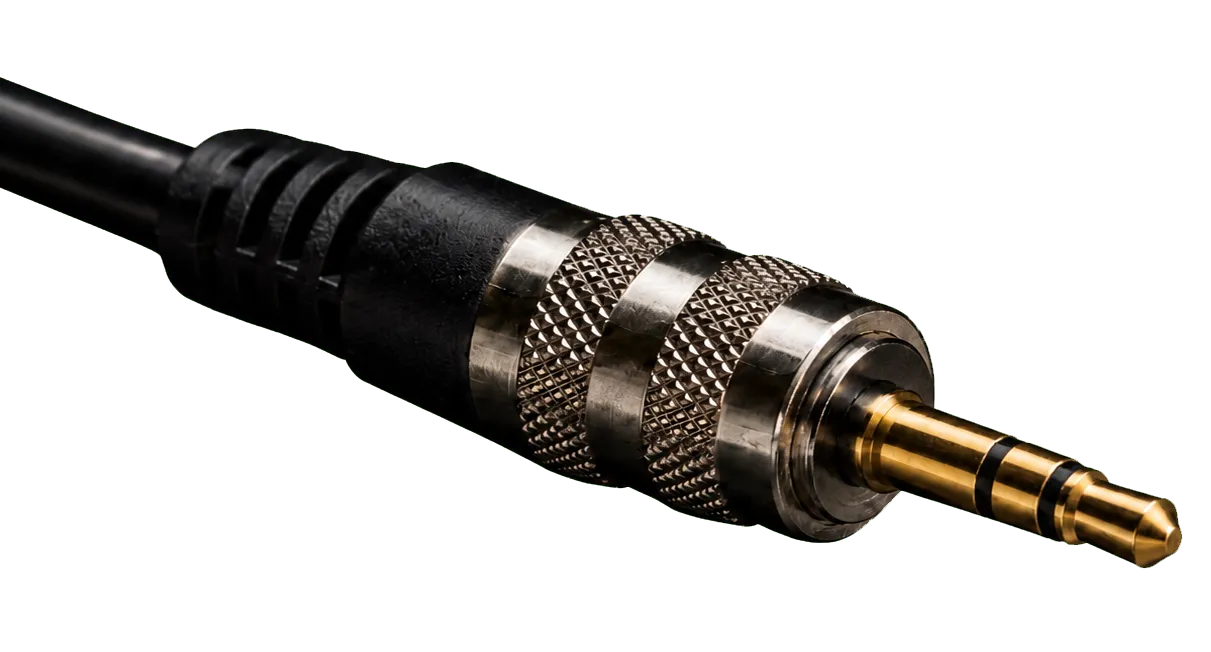
The NET platform provides the same core functions in both versions. Select the connector that matches your 10Micron controller.
Dedicated version for 10Micron V3 controllers with direct hardware status monitoring.
Dedicated version for 10Micron V2 controllers with status monitoring over native TCP/IP.
Same network-first architecture. Different controller connection.
SkySwitch Pro NET is an embedded control and synchronization system designed specifically for remotely operated 10Micron observatories. Once configured, the device continues to monitor the mount, acquire environmental and GPS data, execute synchronization workflows and manage scheduled power operations without requiring the Windows application to remain open. The application provides configuration, diagnostics and a live operational view, while the time-critical and safety-related functions are executed locally by the device firmware.
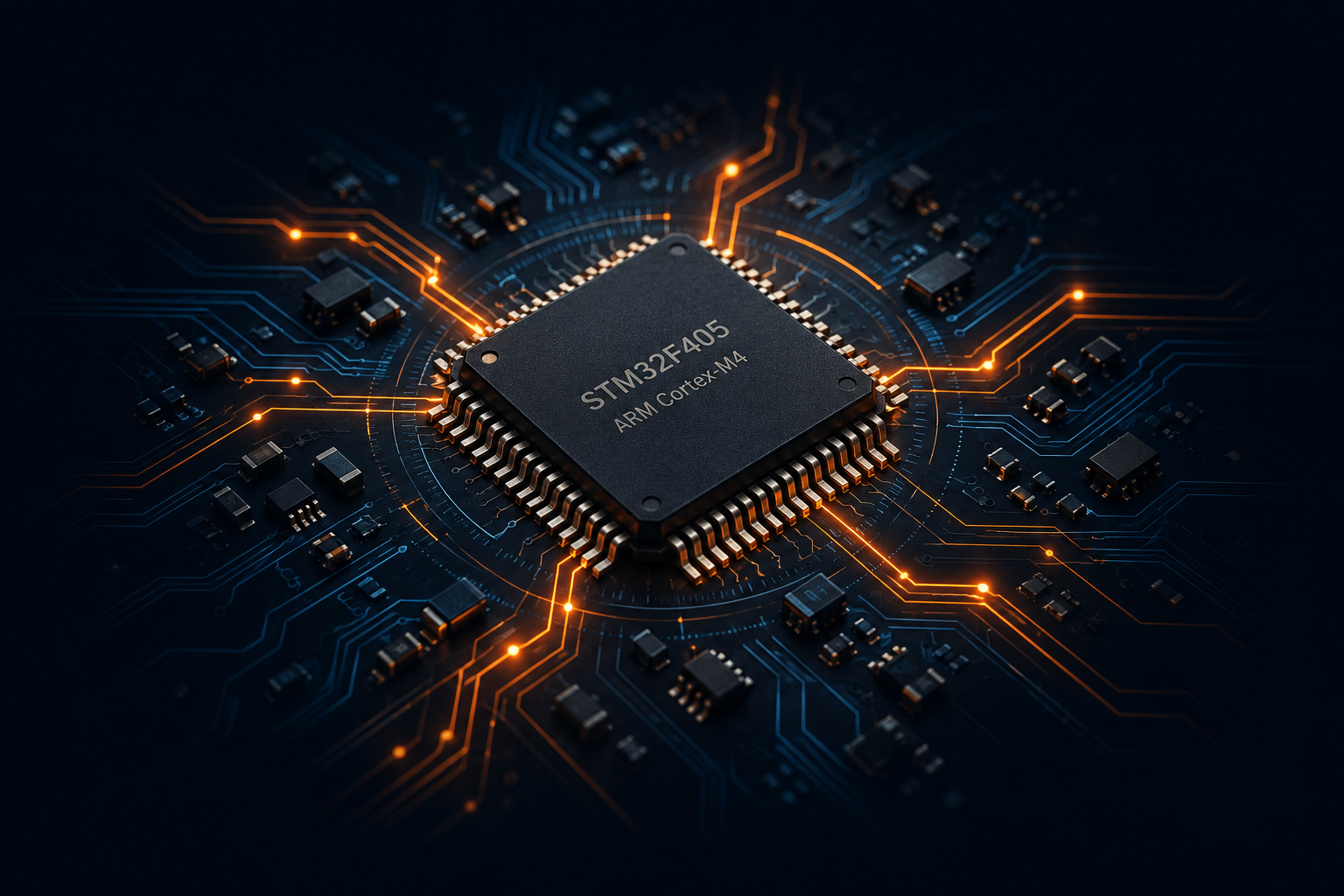
At the heart of SkySwitch Pro NET is a powerful STM32F405 microcontroller based on the 32-bit ARM Cortex-M4 architecture with hardware floating-point support. It runs the complete embedded control logic locally: acquiring sensor data, evaluating GPS and PPS readiness, communicating with the mount and executing automation policies stored in the device. Configuration is preserved in non-volatile memory and remains active after a restart or temporary loss of the application connection. The optional USB connection is intended primarily for initial setup, service and recovery; connecting or disconnecting USB does not interrupt normal Ethernet operation, weather delivery, synchronization or power scheduling.
A dedicated hardware Ethernet controller provides a fast and stable connection between SkySwitch Pro NET, the control computer and the 10Micron mount. Link monitoring, validated protocol responses, controlled reconnect logic and automatic recovery from communication faults are handled directly by the firmware. The device communicates with the mount through the official 10Micron TCP/IP command set, without routing operational data through an ASCOM driver. Network control also removes the need to run a long USB data cable from the observatory computer across or around the moving telescope mount. SkySwitch Pro NET can remain close to the mount controller while the operator connects through the local network, reducing cable drag, movement restrictions and the risk of an interrupted USB connection.
The integrated Bosch BME280 sensor continuously measures temperature, atmospheric pressure and relative humidity. Temperature and pressure are delivered directly to the mount for atmospheric refraction compensation, while humidity and calculated environmental values remain available for monitoring and diagnostics. Measurements are evaluated every five seconds, but updates are transmitted only when the temperature changes by at least 0.2°C, pressure changes by at least 0.3 hPa, or the refresh interval expires. Every update is acknowledged and verified by reading the value back from the mount, reducing the risk of silently accepting an incomplete or rejected command.
SkySwitch Pro NET combines a high-sensitivity GPS receiver with a dedicated hardware PPS input captured on a microsecond-resolution time base. Synchronization is enabled only after configurable quality requirements have been satisfied, including satellite count, HDOP, data age, valid altitude, PPS lock and a stable-fix interval. For UTC synchronization, the firmware collects a series of mount-time measurements, selects the samples with the lowest round-trip delay and estimates the remaining clock offset. Any correction is followed by a separate verification series, providing measured confirmation of the final result rather than relying on an unverified time-setting command. Geographic position and altitude are transferred as one controlled synchronization operation.
Remote ON/OFF control reproduces the mount controller’s physical power-button action using a precisely timed two-second hardware pulse. Before the pulse begins, the operation is recorded in redundant non-volatile storage, protecting against duplicate switching after a restart or interrupted command. V3 hardware reads the controller’s dedicated MAIN ON signal for direct power-state monitoring, while V2 determines availability through native network communication with the mount. Scheduled ON and OFF operations are performed locally by the device after configuration. A scheduled shutdown is permitted only when the mount has been confirmed as safely parked; tracking or an uncertain mount state blocks the operation.
The SkySwitch Pro NET application brings device status, mount communication, environmental measurements, GPS/PPS quality and autonomous operations into one consistent interface. It clearly distinguishes live, stale and unavailable information, allowing the operator to understand not only whether a function is enabled, but whether it is ready and working as expected.
The application configures and supervises the system, while time-critical operations continue independently in the embedded device. Closing Windows or losing the application connection does not stop weather delivery, synchronization policies or the stored power schedule.
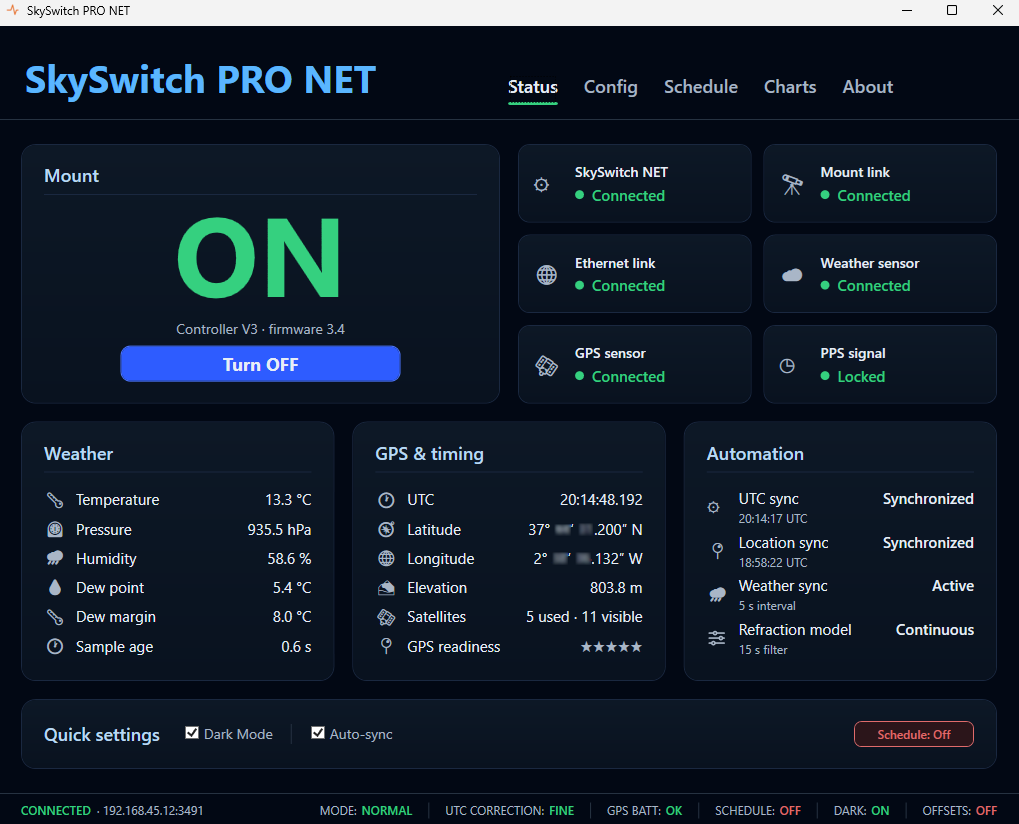
Click the screenshot to enlarge.
The Status view puts mount power control and live operational awareness in one place. From this screen, the user can switch the mount on or off, check its current operating status and monitor the connections between SkySwitch, the observatory network and the mount. Environmental measurements, GPS location and PPS timing are presented alongside the current synchronization state of UTC time, location and weather data — making it clear not only what the system is measuring, but whether that information is being successfully synchronized with the mount.
The Quick settings bar offers one-click control of Dark Mode and automatic synchronization without opening the configuration pages. A persistent status bar keeps essential system information visible, including connection state, operating mode, UTC correction status, GPS battery condition, scheduling and sensor offsets — providing a practical overview without leaving the Status screen.
SkySwitch Pro NET is not a fixed-function accessory. Its operating policies can be adapted to the network, mount, GPS reception and automation requirements of a specific observatory. The application provides a clear configuration environment, while the resulting settings are stored and executed inside the embedded device. Once configured, the system continues performing its operational tasks without depending on a permanently running Windows application.
Click any screenshot to inspect the interface in full size. All configuration capabilities are described below.
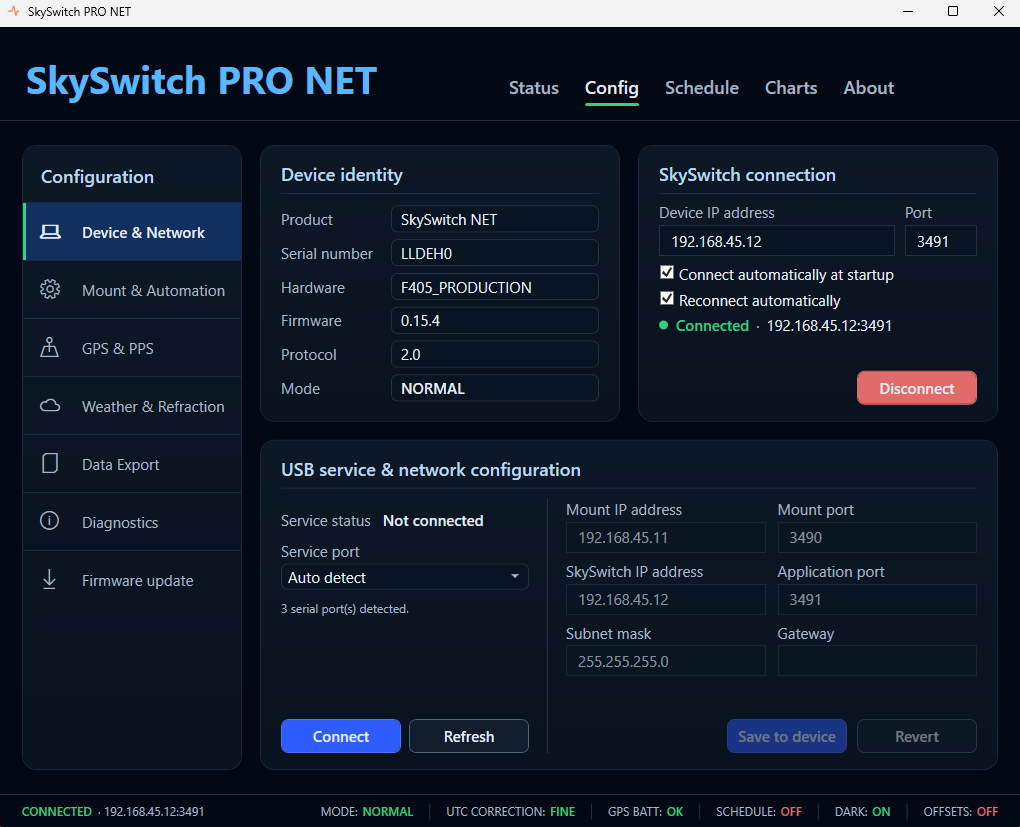
USB SERVICE provides a direct and dependable way to define the SkySwitch and mount IP addresses during initial installation — even before the device is reachable through the observatory network. Once configured, normal operation moves to fast, reliable Ethernet communication, removing the need for a permanent USB data connection and avoiding cables that could restrict telescope movement. Network settings are written to the device, read back and verified before the application changes to the new connection. Automatic reconnection restores communication after temporary interruptions, while the independent USB service path remains available for maintenance and recovery if a configuration error or network failure makes the device unreachable.
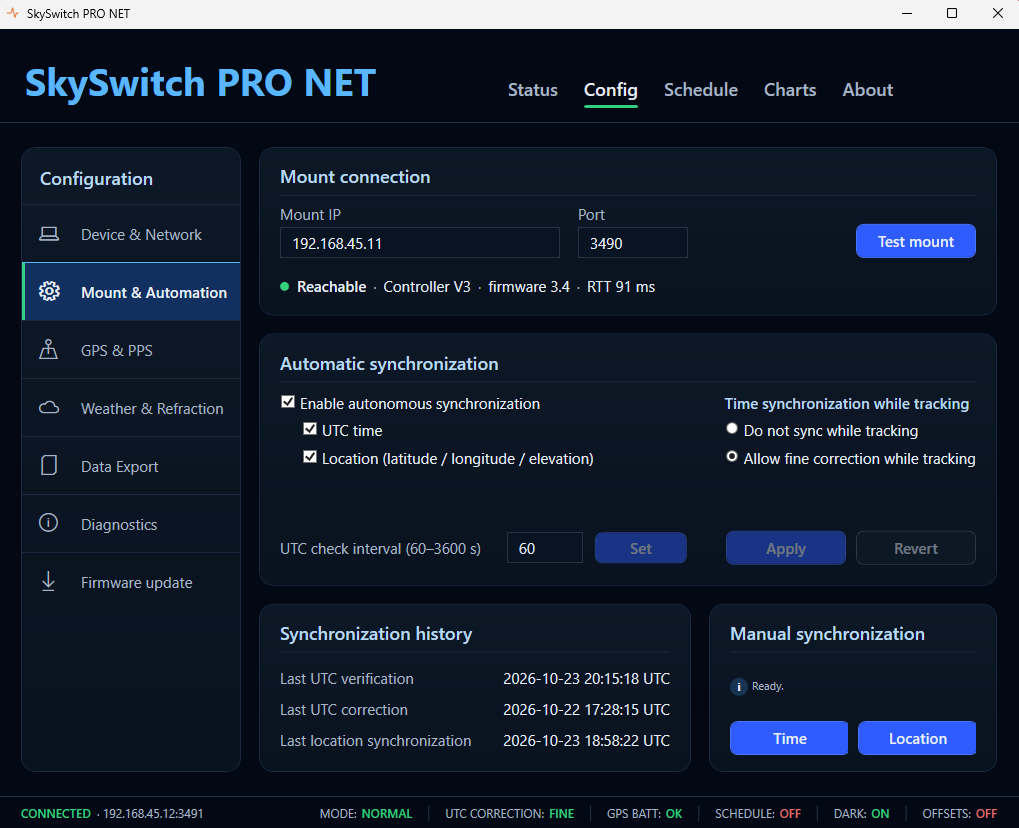
The user decides which information SkySwitch Pro NET may synchronize with the mount: precise UTC time, geographical position and elevation. Time verification can run automatically at a selected interval, while location synchronization remains independently controlled. Corrections may be restricted to a parked or safely stationary mount, or fine time correction may be permitted during active tracking. Even then, the firmware imposes a hard 50-millisecond limit to protect the current exposure; larger deviations are detected but deferred until a full synchronization can be performed safely. Before every operation, the device checks the mount state, automatically blocking synchronization during slewing, parking, unparking, homing or any uncertain condition.
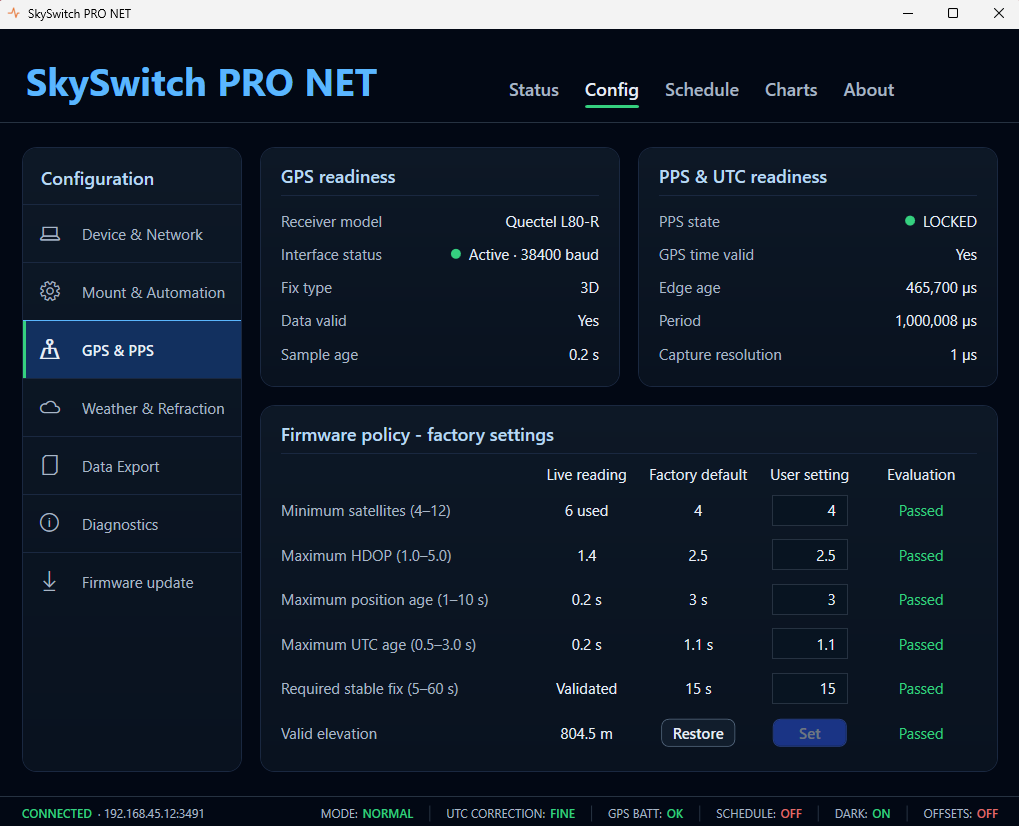
GPS reception differs between observatories, so SkySwitch Pro NET allows the acceptance policy to be matched to local conditions. The user can define the minimum satellite count, maximum HDOP, maximum age of position and UTC data, required stable-fix duration and the requirement for valid elevation. The PPS signal is evaluated separately from the navigation fix: hardware-captured pulses are correlated with consecutive valid GPS time epochs before the reference is considered locked. An isolated pulse or a single valid NMEA message is never enough. Factory values provide a safe starting point, while validated user limits are stored in the device and continue governing autonomous synchronization without the Windows application.
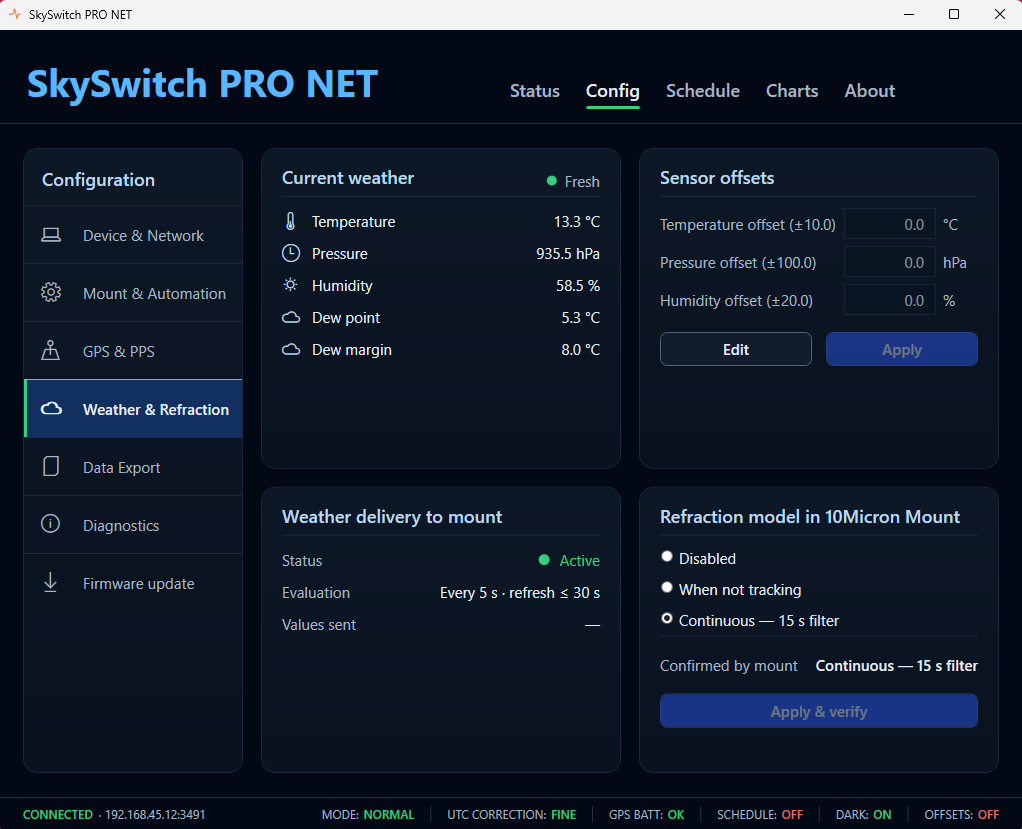
The integrated environmental sensor does more than display observatory weather. It continuously provides temperature and atmospheric pressure used by the 10Micron mount for atmospheric-refraction compensation — an important factor in maintaining pointing and tracking accuracy as conditions change. Temperature, pressure and humidity can be calibrated against a trusted reference. Measurements are evaluated every five seconds and transmitted when a meaningful change is detected, with a maximum refresh interval keeping the mount supplied with current data during stable conditions. The user can choose whether the mount updates its refraction model only while not tracking, continuously with its 15-second smoothing filter, or not automatically at all. The selected mode is read back and confirmed by the mount.
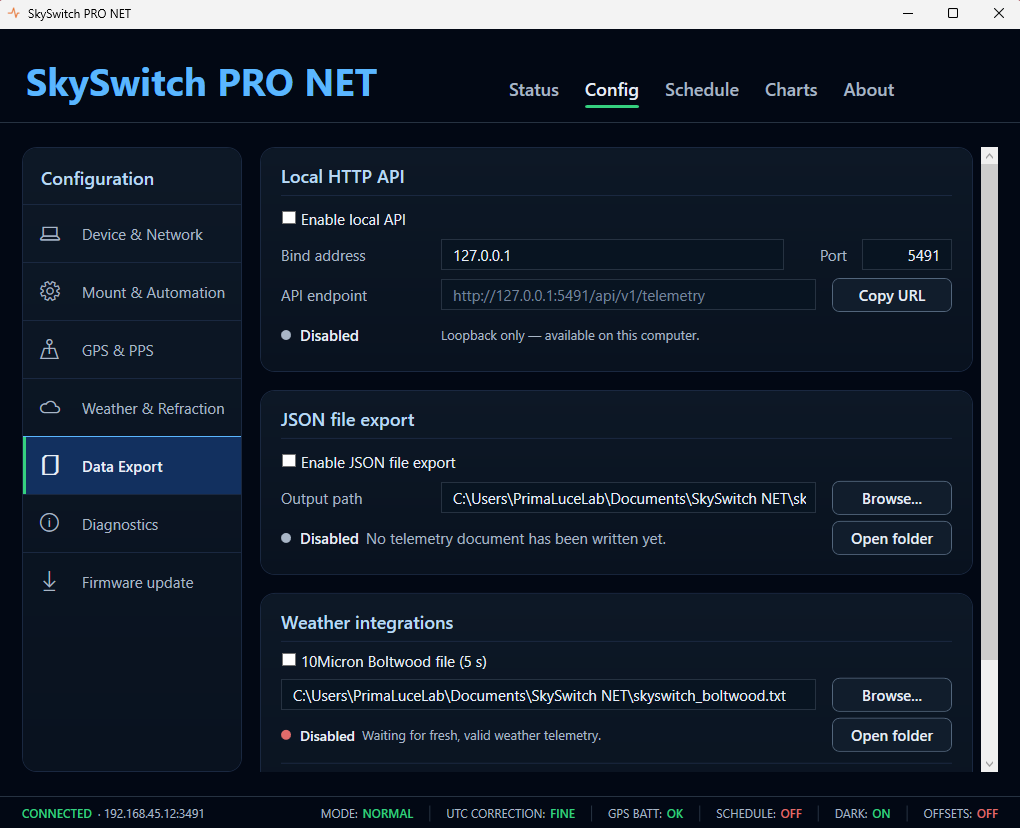
The information collected by SkySwitch Pro NET is not locked inside its application. A local HTTP API provides a structured operational snapshot for automation and monitoring software. Atomic JSON export maintains a continuously updated machine-readable file without exposing partially written data to another process. CSV history records qualified environmental measurements for later analysis and archiving, while a 10Micron-compatible Boltwood file supports established observatory software. Every output originates from the same validated telemetry pipeline used by the application, allowing one sensor and one device connection to serve the mount, the operator interface and external integrations without competing communication sessions.
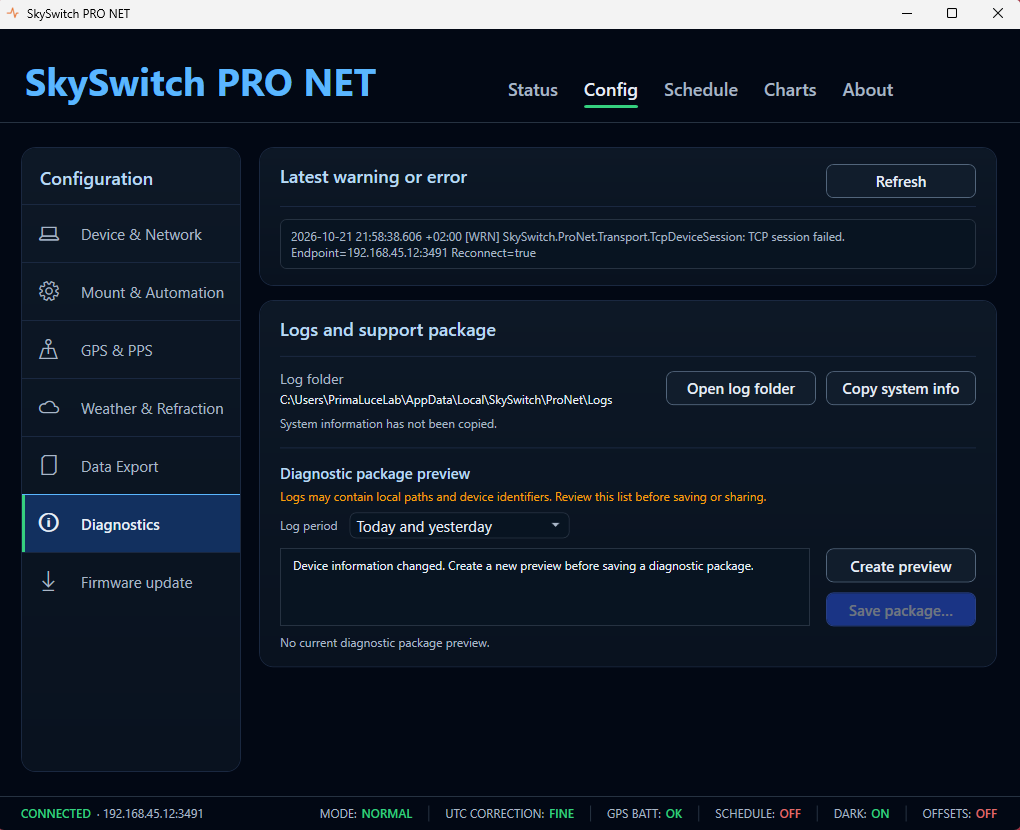
Remote-observatory problems are often difficult to reproduce. SkySwitch Pro NET preserves the operational context needed to understand temporary network interruptions, degraded GPS reception, delayed mount responses and other intermittent events. Diagnostics combines significant warnings, communication history and system information into a support package prepared for a selected period. Before the archive is created, the application shows exactly which files will be included and removes sensitive values from the collected logs. Instead of relying on screenshots or incomplete descriptions, the user can preserve structured technical evidence that makes troubleshooting faster and more conclusive.
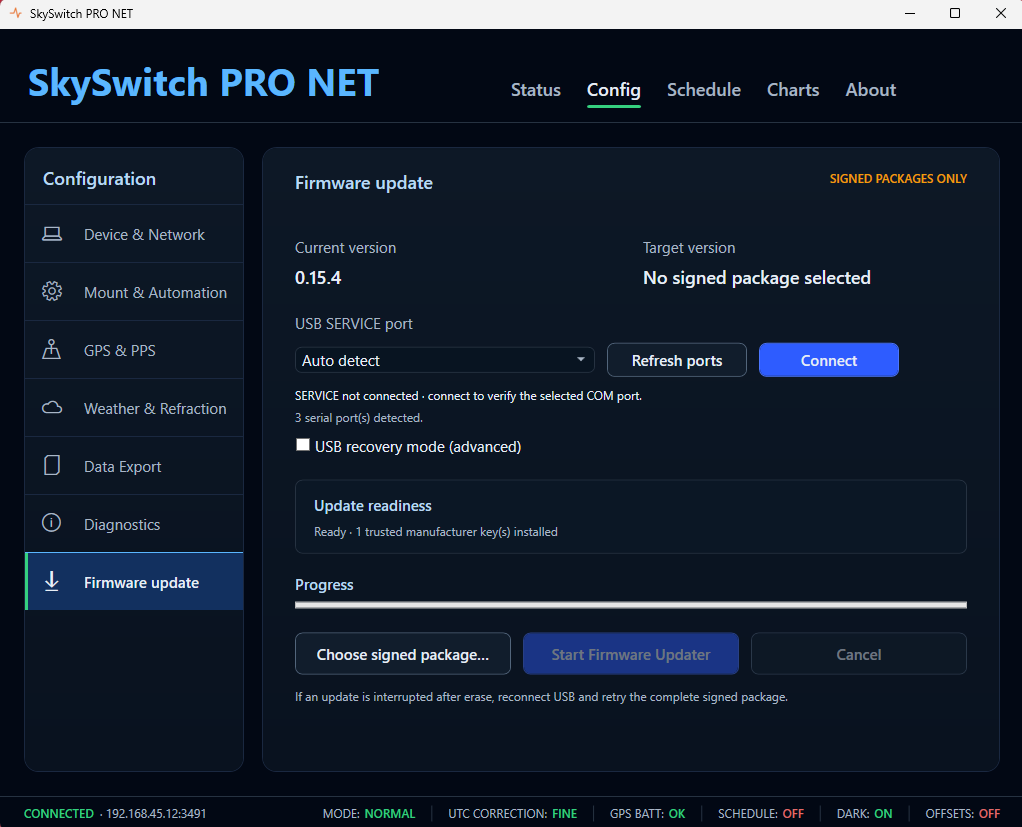
SkySwitch Pro NET accepts complete production packages signed by the manufacturer and verifies their identity, intended hardware, cryptographic signature and SHA-256 checksum before programming begins. After the firmware is written, device memory is read back and compared with the signed image. The controller is then restarted, Ethernet communication is restored and the reported firmware version is checked against the expected release. Success therefore means more than completing a progress bar: it confirms that the correct firmware was written, verified and is actually running. If an update is interrupted, the independent USB SERVICE path and recovery mode provide a controlled route back to operation.
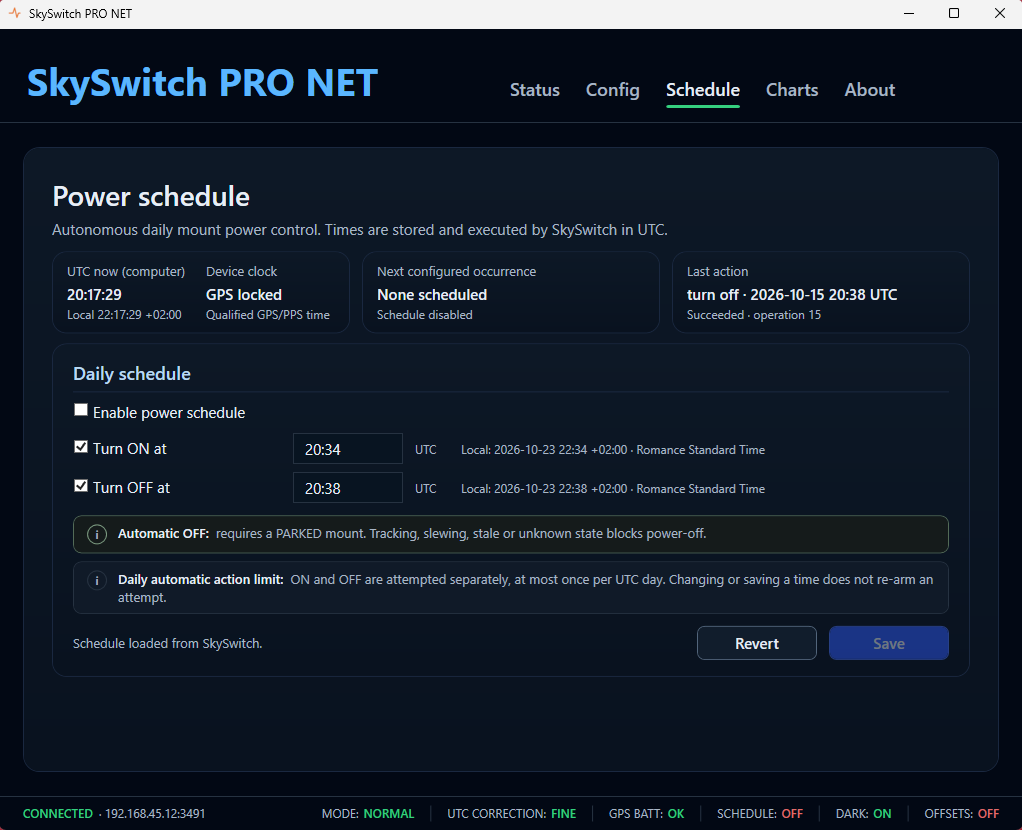
Define daily ON and OFF times in the Windows application, then let SkySwitch Pro NET execute the stored schedule locally. The schedule runs in UTC inside the device, so the application does not need to remain open for planned power operations.
Scheduled shutdown is permitted only after the mount has been confirmed as safely parked. Tracking or an uncertain mount state blocks the operation. Power actions are recorded in non-volatile storage to guard against duplicate switching after a restart or an interrupted command.
Click the screenshot to enlarge.
Click the screenshot to enlarge.
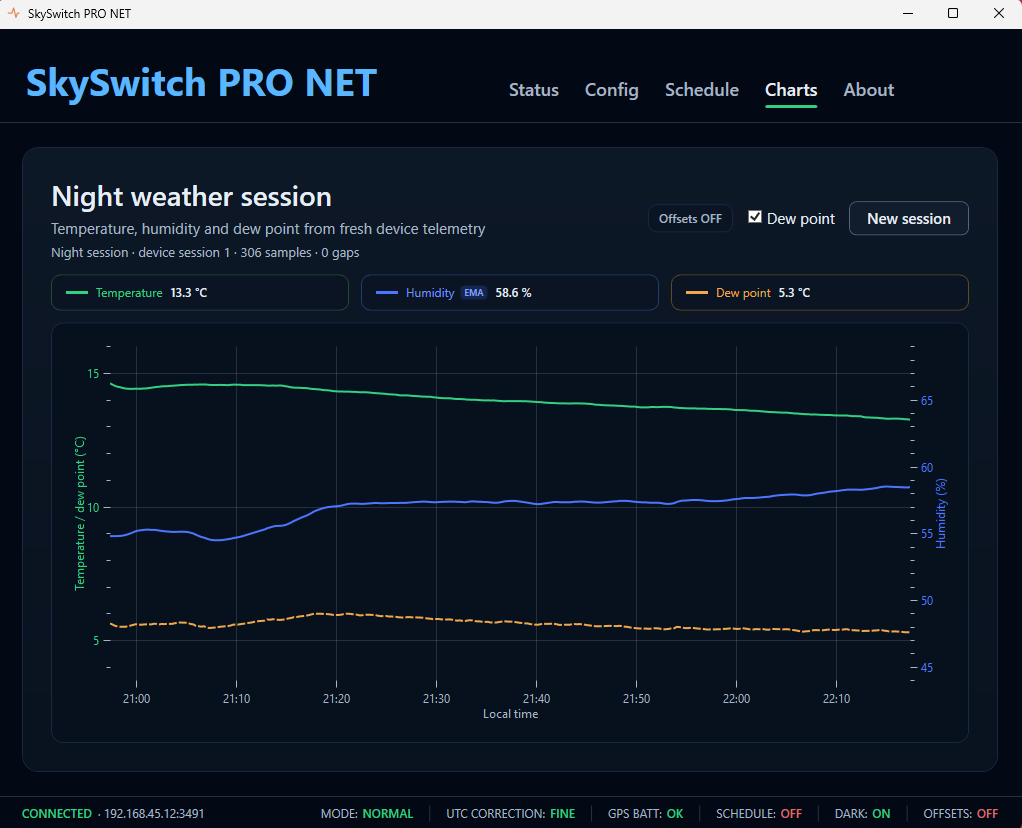
The Charts view presents recorded temperature, pressure, humidity, dew point and related environmental measurements over time. Separate acquisition sessions and communication gaps remain visible rather than being silently joined, so missing data cannot be mistaken for a continuous series. This makes trends easier to interpret and provides reliable historical context for changing observatory conditions.
Key hardware and system parameters of SkySwitch PRO NET.